No, OpenAI Didn't Break Ethereum — 'ETH' Here Means Something Else
OpenAI says its AI disproved 'ETH' — but it's a 1999 math theory, not Ethereum. Crypto traders panicked for nothing.
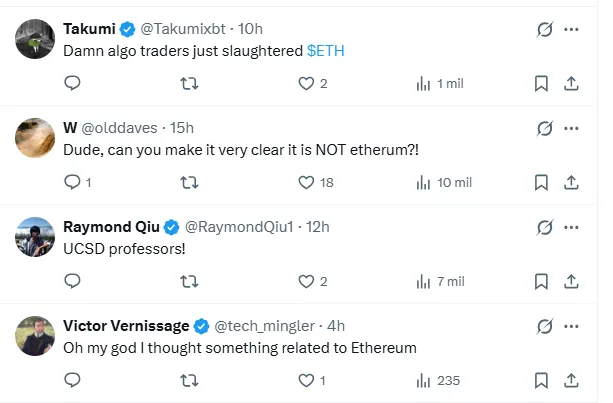 Image source: Decrypt
A confusing headline sent crypto traders into a brief panic — but it was all a misunderstanding.
OpenAI, the company behind ChatGPT, announced that its AI had proven "ETH is false." Crypto fans immediately assumed this meant something terrible had happened to Ethereum (ETH), the second-biggest cryptocurrency in the world. One trader joked that algorithms had "slaughtered" ETH.
But relax — this "ETH" has nothing to do with cryptocurrency.
The "ETH" in question is the Exponential Time Hypothesis, a 26-year-old idea from computer science. In plain English, it's a theory about which problems computers probably can *never* solve quickly, no matter how powerful they get. OpenAI claims its AI found a clever shortcut that disproves this long-standing belief.
Here are the key facts:
- OpenAI published a 67-page paper on October 25, 2026, claiming the breakthrough.
- The AI reportedly found the solution on October 16, and it was checked by special verification software (called Lean) the next day.
- The three scientists who originally proposed the theory in 1999 are now independently reviewing the work.
- Rival AI company Anthropic (maker of the Claude AI) quickly posted its own similar paper days later.
The researchers also noted this discovery is mostly theoretical. Real-world benefits — like faster computers or smarter software — are still far away and would need "significant further research."
The bottom line: Ethereum's price was never in danger. This was a math and computer-science story, not a crypto story. The episode shows how AI is increasingly being used to tackle — and sometimes solve — problems that stumped humans for decades. It also highlights how easily a technical headline can spook jittery traders.
This is an AI-generated summary. Read the original article at: https://decrypt.co/381956/opena-eth-false-crypto-twitter-has-questions